
Home Tabor | Desktop Model P2588D
Tabor | Desktop

Model P2588D

Rs. 8571611.00

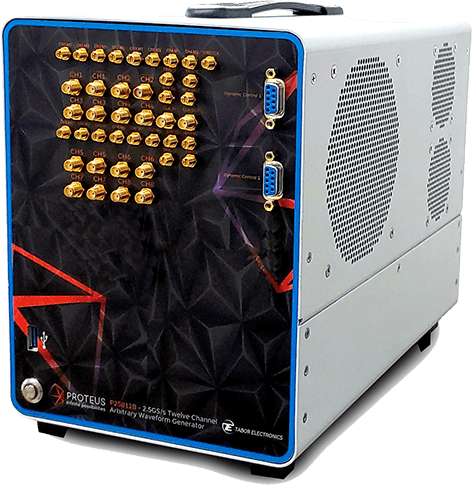
The Tabor P2588D is an advanced PXIe module featuring 8 AWG channels at 1.25 GS/s (16‑bit) and 8 digitizer channels at 1.5 GS/s (12‑bit). Each AWG channel includes 4 GS of waveform memory and 8 marker outputs. With integrated NCO, onboard FPGA, real-time streaming, closed-loop feedback, and conditional sequencing, it supports sophisticated multi-channel test setups for radar, quantum control, and high-speed communications..

  • Detail
  • Special Features
  • Specification

The P2588D combines high-channel-count waveform generation and acquisition in a single compact PXIe module. The onboard FPGA and real-time sequencer enable responsive, condition-driven waveforms and closed-loop control without PC intervention. Perfect for large-scale synchronized applications like phased-array radar, quantum testbeds, and multi-channel communications systems. A scalable, modular design ensures seamless integration into high-density PXIe configurations.

  • Eight AWG channels (1.25 GS/s, 16‑bit DACs)

  • Eight digitizer channels (1.5 GS/s, 12‑bit ADCs)

  • 4 GS waveform memory per AWG channel

  • Eight marker outputs per channel for precise synchronization

  • Integrated NCO for RF/microwave signal synthesis

  • Task-based sequencer with conditional execution

  • Real-time streaming to FPGA for infinite waveform length

  • Feedback-control architecture enabling dynamic output adjustments

  • User-programmable FPGA for custom signal processing

  • High-speed PCIe Gen3 ×8 interface (~64 Gb/s) for scalable PXIe systems

Parameter Value
Model P2588D
Platform PXIe (PCIe Gen3 ×8)
AWG Channels 8 (1.25 GS/s, 16‑bit)
Digitizer Channels 8 (1.5 GS/s, 12‑bit)
AWG Memory 4 GS per channel
Marker Outputs 8 per channel
NCO Yes
FPGA User-programmable
Sequencer Task-based with conditional logic
Streaming Capability Real‑time waveform streaming to FPGA
Interface Speed ~64 Gb/s
Form Factor PXIe module, 3-slot (12 HP)
Scalability High – modular multi-module systems